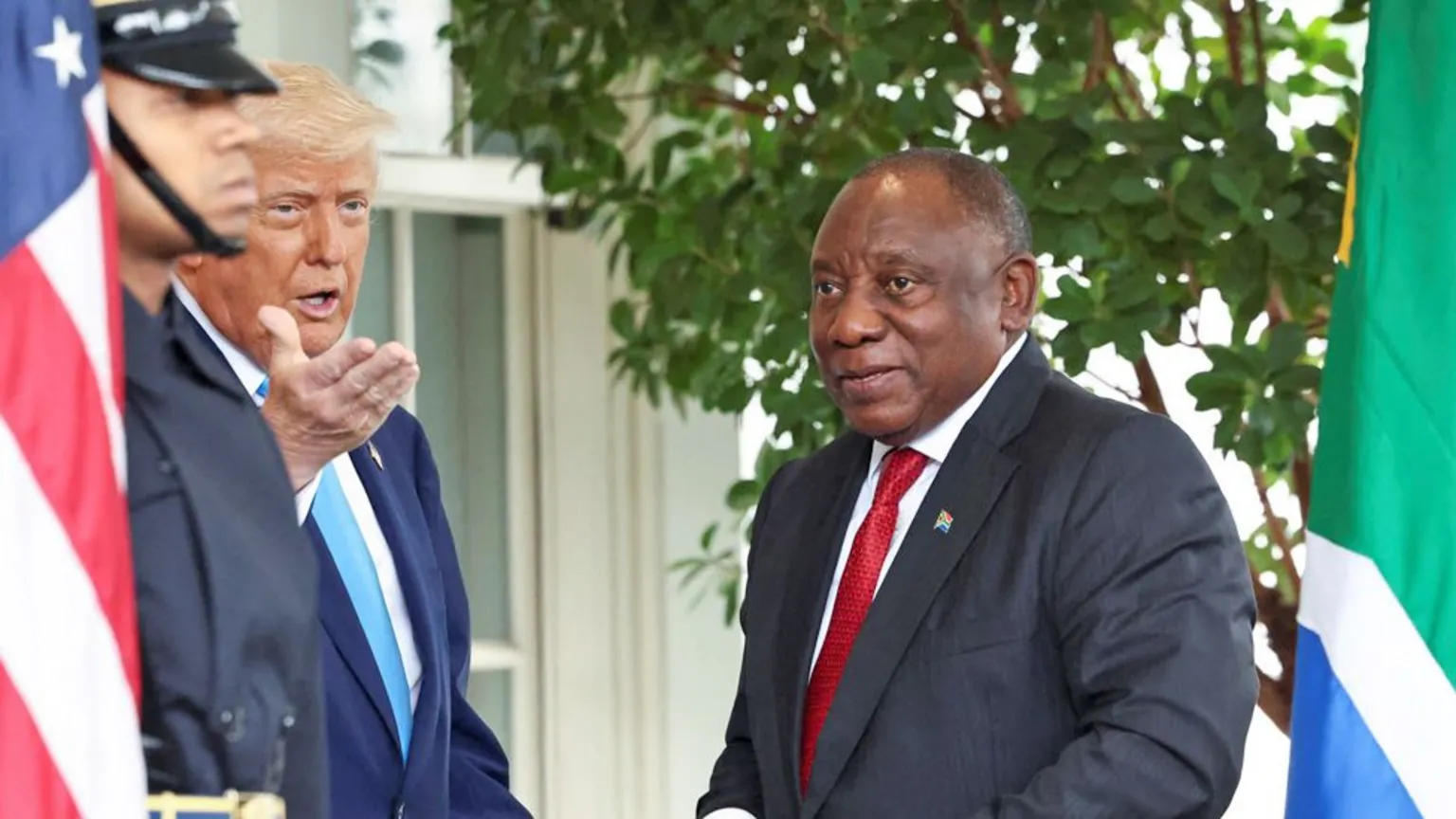
Ties between the United States and South Africa have sunk to a new low after President Donald Trump declared that South Africa no longer deserves a seat at the G20 table. His remarks have sparked a diplomatic storm just weeks before Johannesburg hosts leaders from the world’s largest economies.
Speaking at a conference in Miami, Trump said he would skip the upcoming summit and instead send Vice-President JD Vance to represent Washington.
“South Africa shouldn’t even be in the Gs any more, because what’s happened there is bad. I’m not going to represent our country there. It shouldn’t be there,” he said, renewing his long-running criticism of South Africa’s land and race policies.
Pretoria has chosen not to respond directly to Trump’s attack. However, Presidential spokesperson Vincent Magwenya told the BBC that preparations for the meeting were on track, adding that South Africa was confident of hosting a “productive and successful” gathering of global leaders.
The G20, created in 1999 following the Asian financial crisis, serves as an informal platform for countries representing most of the world’s economic output. Because it is not bound by a legal charter, there is no official mechanism to remove a member.
Dr Andrew Gawthorpe from the Foreign Policy Centre explained that any exclusion would rely entirely on agreement among participating states. “If a country was going to be kicked out, it would mean that it was not invited to attend. But that kind of decision would require the support of nearly all other members, which is extremely unlikely,” he said.
Policy analysts believe Trump’s demand will fail to gain traction. Chris Vandome, a senior fellow at Chatham House, noted that both Europe and Asia have strong ties with South Africa.
“The European Union has major financial commitments with South Africa and across Africa. And on the Asian front, China would not allow a move to isolate Pretoria,” he said.
The latest clash follows months of growing tension. Washington recently imposed steep tariffs, up to 30%, on South African exports, after Trump accused Ramaphosa’s administration of mistreating white farmers.
Earlier this year, the US leader also announced plans to offer refugee status to white Afrikaners after South Africa approved limited land expropriation without compensation.
South Africa has firmly denied claims of racial persecution, stating that crime affects citizens of all backgrounds equally. Government officials also described the “white genocide” narrative promoted by Trump and his allies as false and unsupported by evidence.
South Africa’s foreign ministry spokesperson Chrispin Phiri said the country’s G20 theme—“solidarity, equality and sustainability”—captures its vision for inclusive growth. “From our history of overcoming division to building democracy, South Africa stands ready to advocate within the G20 for shared prosperity and collective action for sustainability,” he said.
Despite the mounting tensions, South Africa has opted for restraint, choosing to focus on hosting the summit successfully rather than responding to Trump’s repeated provocations.